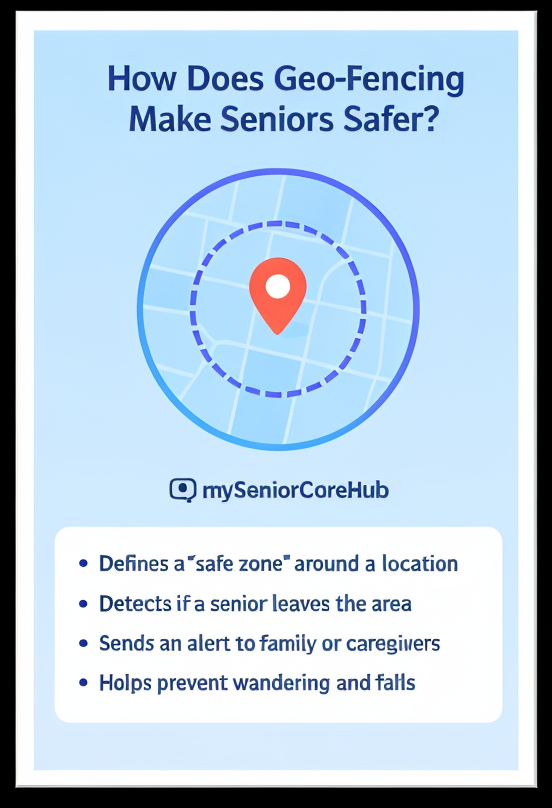
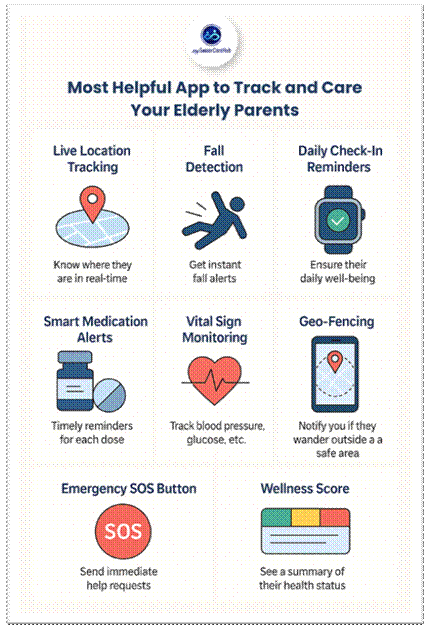
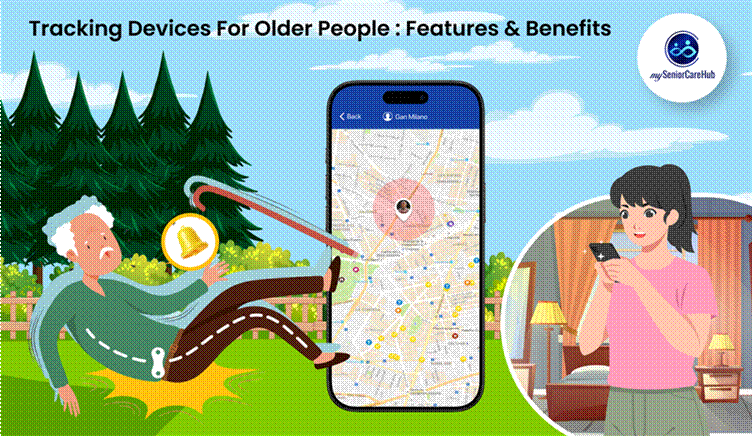
Yes apps like mySeniorCareHub offer geofencing features that notify you immediately if your elderly parent steps out of a defined safe area.
Caring from a Distance, Without Intrusion
If your aging parent lives alone or is dealing with memory loss, every moment of silence can trigger anxiety. Missed calls, delayed walks, and unannounced outings aren’t always emergencies but they feel like they could be.
You don’t want to invade their independence. But you do want a way to be alerted if something’s off. That’s where geofencing steps in—a smart, respectful solution offered by mySeniorCareHub’s Location Tracking App.
What Is Geofencing and How Does It Work?
Geofencing allows you to set up virtual boundaries also called “safe zones” around familiar areas like home, local parks, temples, or the grocery store. Once set, the app will instantly notify you if your parent crosses those boundaries.
Why mySeniorCareHub Is the Best Geofencing App for Seniors
Unlike generic tracking apps, mySeniorCareHub is designed for senior care. It offers safety features with a human touch balancing independence with support.
Create multiple geofences based on your parent’s daily routine,not just fixed circles on a map.
🔔 Intelligent Alerts
Get notified only when it matters. Avoid false alarms and unnecessary panic.
📍 Real-Time Path Tracking
See your parent’s current route in real time—without having to call or text repeatedly.
🚨 Integrated Fall Alerts
If a fall occurs outside the safe zone, the app sends both a fall alert and exact GPS location instantly.
📱 No Wearables Needed
No smartwatch or extra device required—just a smartphone and a simple setup.
Learns Their Routine Over Time
As your parent continues to use the app, mySeniorCareHub adapts to their habits. It recognizes patterns like your mother’s evening temple visits or your father’s morning walks and reduces unnecessary alerts while keeping you informed of unusual activity.
You’re Not Monitoring, You’re Caring
Installing the mySeniorCareHub Location Tracking App isn’t about surveillance. It’s about building a silent safety net one that empowers you to act when it truly matters, and empowers your parent to live freely.
Because real caregiving isn’t about watching every move, it’s about being there right when you’re needed. And with mySeniorCareHub, you always will be.
In 2026, safety and independence are no longer a trade-off. As the senior population grows, with projections indicating that by 2036, nearly 1 in 7 people will be over 60, technology has stepped up to bridge the gap between caring and hovering.
Whether your parents are aging in place or navigating early cognitive changes, a reliable GPS tracking app is the ultimate safety net. Here is the definitive guide to the best GPS tracking apps for elderly parents in 2026, featuring the latest data and our top pick for the year.
Why Seniors Need GPS Tracking? (The Stats)
The demand for “Aging in Place” has hit an all-time high. Recent 2025-26 data highlights why location-aware care is essential:
Wandering Risks: Research from NIH shows that up to 60% of people with dementia will wander at least once, potentially leading to dangerous disorientation.
The “Alone” Factor: Approximately 25% of older adults are “solo agers” living alone, increasing the need for remote monitoring.
Fall Hazards: Falls remain the leading cause of injury-related emergency visits for those over 65. In 2026, mobile app connectivity for fall detection has grown by 28% to address this.
Smartphone Adoption:89% of adults aged 50+ now own a smartphone, making app-based solutions more accessible than bulky, expensive hardware.
The #1 GPS Tracking App of 2026: mySeniorCareHub
After evaluating the latest software-based tracking solutions, mySeniorCareHubapp stands out as the premier choice for 2026.
While other apps focus solely on dots on a map, mySeniorCareHub integrates location with comprehensive health management, all without requiring extra wearable devices.
Key Features That Set It Apart:
Real-Time Precision Monitoring: Offers high-accuracy GPS Tracking that works both indoors and outdoors, ensuring you know exactly where your parent is, whether they’re at the local market or a friend’s home.
Advanced Geofencing (Safe Zones): You can set virtual boundaries around “safe” areas. If your parent leaves these zones, you get an instant smartphone notification crucial for preventing wandering incidents before they escalate.
Integrated Fall Detection: Utilizing the smartphone’s internal sensors (accelerometers), the app detects sudden impacts and automatically shares the senior’s exact location with emergency contacts.
Zero Hardware Maintenance: Unlike pendants or watches that require constant charging and can be easily forgotten, mySeniorCareHub lives on the phone they already carry.
Holistic Health Dashboard: It’s more than a tracker. Caregivers can monitor blood pressure, blood sugar, and medication schedules within the same interface.
Comparing the Top GPS Solutions of 2026
Features
mySeniorCareHub
Traditional Wearables
Standard “Find My” Apps
Device Required
Smartphone Only
Proprietary Watch/Pendant
Smartphone
Fall Detection
Included (App-based)
Included (Hardware)
None
Health Monitoring
BP, Sugar, Meds
Heart Rate only
None
Ease of Use
Senior-Optimized UI
Often tiny buttons
Not senior-focused
Cost
Low (No hardware fee)
High (Device + Monthly)
Free (But limited)
Built for the “Tech-Savvy” Senior
A common misconception is that seniors can’t use apps. However, 98% of seniors with mobile phones use them every day. Our mySeniorCareHub app is designed with this reality in mind, featuring:
High-Contrast Design: Large icons and clear text for those with visual impairments.
SOS Quick-Action: A prominent emergency button that triggers an alert and shares location data in one tap.
Voice Integration: Compatible with voice commands for seniors who prefer talking over typing.
Final Verdict: Why mySeniorCareHub Wins
In 2026, the best care is the kind that doesn’t feel like a burden. mySeniorCareHub app provides the “invisible” safety net that families need. It empowers seniors to maintain their dignity and independence while giving caregivers the data-driven peace of mind they deserve.
By combining GPS tracking with vital health metrics and fall detection, it is the most comprehensive, cost-effective, and user-friendly tool available for senior safety today.
Is a GPS tracking app better than a wearable GPS watch?
In 2026, many families prefer apps like mySeniorCareHub over hardware because they eliminate “device fatigue.” Wearables require daily charging, can be uncomfortable, and are often forgotten on the nightstand.
Since 89% of seniors carry their smartphones, app-based solutions ensure tracker is always there without adding burden of extra gear.
How does the “Fall Detection” work without a wearable sensor?
Modern smartphones in 2026 are equipped with high-precision accelerometers and gyroscopes. mySeniorCareHub app uses advanced AI algorithms to distinguish between a phone being dropped and a “human-scale” fall.
If a potential fall is detected, app triggers and sends an alert with senior’s exact coordinates to emergency contacts immediately.
Does GPS tracking drain the phone’s battery?
While older GPS technology was notorious for battery drain, the 2026 version of mySeniorCareHub is optimized for “Passive Monitoring.”
It uses a combination of GPS, Wi-Fi triangulation, and cellular towers to minimize power consumption, ensuring the phone stays charged throughout the day while still providing real-time updates.
How do I talk to my parents about using a tracking app without upsetting them?
Privacy is the #1 concern for seniors. Experts suggest framing the conversation around “mutual peace of mind” rather than “monitoring.”
The Safety Net: Remind them that in 2026, 6 in 10 seniors with memory issues may experience disorientation; having a safety net isn’t about losing freedom; it’s about protecting it.
Highlight Independence: Explain that our mySeniorCareHub app actually allows them to go on walks and travel more freely because help is just one tap away.
Focus on Health: Since mySeniorCareHub also tracks vitals like blood pressure and medication, it feels less like a “tracker” and more like a comprehensive health assistant.
Keeping track of elderly loved ones shouldn’t feel like a chore or an invasion of privacy. In 2026, the best location tracking apps balance smart safety with personal independence.
Whether you’re a “sandwich generation” parent managing kids and aging parents, or simply want to ensure your family’s devices are secure, finding the right tool is the definitive way to gain peace of mind.
In 2026, mySeniorCareHub stands out as the premier choice for families who need more than just a dot on a map – it’s a comprehensive wellness companion.
Quick Answer: 2026 Winners
In 2026, If you’re in a hurry to find the perfect location tracking app, here’s the bottom line:
Better Choice for Teens Families: Life360 – A gold standard for real-time “circles” and driving safety.
Best for Device Security: Apple Find My (iOS) & Google Find My Device (Android).
Overall Best App for Seniors: mySeniorCareHub – Specifically built for elder care with fall detection and safety + health integration.
Protect Your Elderly Loved Ones Today
Join thousands of families using mySeniorCareHub to ensure their parents stay safe and independent
Why Location Tracking Matters in 2026 – Caring Smarter, Not Harder
Location tracking offers real-time visibility and emergency alerts, helping caregivers stay connected while respecting a senior’s dignity.
But not all tracking is created equal. To ensure an app actually helps (without draining battery or causing “monitor fatigue”), it must rest on five pillars:
Why mySeniorCareHub is the Best for “Aging in Place”
Most apps track phones; mySeniorCareHub tracks wellness. It is a comprehensive safety companion designed to keep seniors independent while giving families peace of mind.
Daily Wellness Check-Ins: It replaces the “anxious daily phone call” with a simple, one-tap “I’m Okay” button. If a check-in is missed, the care circle is instantly notified.
Built-in Fall Detection: Using advanced smartphone sensors, it detects sudden impacts and alerts emergency contacts—no expensive, clunky hardware required.
Vital Health Tracking: Beyond GPS, it allows seniors to log blood pressure, heart rate, and oxygen levels, creating a health timeline for the whole family.
Smart Geofencing: Get an instant ping the moment a loved one leaves their “Safe Zone” or arrives safely at a doctor’s appointment.
While apps like Life360 are great for teens and Glympse is perfect for temporary ETA sharing, only one app is built specifically for the unique needs of aging parents.
Is the stress of “not knowing” Taking a Toll? Don’t Wait For A Crisis To Happen
What Exactly Is a UTI and Why Are Elderly Women More Prone with UTI?
A urinary tract infection (UTI) happens when bacteria (usually E. coli) enter the urinary system. While UTIs are common at all ages, they’re more frequent and often more serious in elderly women. Here’s why:
Weakened immunity with age makes it harder to fight off infections.
Menopause leads to a drop in oestrogen, thinning the vaginal walls and making the urinary tract more vulnerable.
Catheter use and limited mobility can introduce bacteria.
Incontinence can cause poor hygiene conditions, especially if not managed well.
Symptoms: What Makes It Tricky in Older Women?
Unlike younger women, elderly women often don’t experience the “typical” UTI symptoms. This leads to delayed diagnosis and serious complications like kidney infections or even sepsis.
Typical Signs
Often Overlooked in Seniors
Burning while urinating
Confusion or sudden agitation
Urge to urinate frequently
Lower abdominal pain
Cloudy or foul-smelling urine
Fatigue or low-grade fever
Pain during urination
Delirium, withdrawal, or irritability
This is why monitoring mood, energy levels, and overall well-being daily matters. Here’s a breakdown of the most common myths, the truth behind them, and how smart care tools like mySeniorCareHub can help.
Myth 1: “Drinking less water helps avoid UTIs.”
Reality: It increases the risk. Dehydration concentrates urine, providing bacteria a perfect breeding ground.
Smart Solution: Hydration nudges from mySeniorCareHub gently remind elders to drink enough water throughout the day, without making them feel nagged.
Myth 2: “UTIs are always evident, such as by burning or pain.”
Reality:
Symptoms in older adults may be ambiguous or out of the ordinary. Confusion, fatigue, irritability, and even minor falls could be early signs.
Smart Solution:
The app’s symptom tracking and daily health check-ins can identify changes in vitals, energy, and mood before the infection worsens.
Myth 3: “She’s just getting old, it’s normal to act like this.”
Reality: Mental fog, withdrawal, or agitation are sometimes dismissed as ageing signs. In reality, they could be signs of an untreated UTI.
Smart Solution: The Wellness Score feature in mySeniorCareHub rates key vitals daily and sends alerts for anything unusual, helping family members notice red flags early.
Myth 4: “She already took her medicine—I’m sure of it”
Reality: Missed or incomplete antibiotics are a major reason UTIs return and bacteria become resistant. Many seniors forget doses.
Smart Solution:
The Medication Reminder feature of the app ensures that no dose is missed for elderly women who live alone or have memory issues.
Myth 5: “Wearing adult diapers keeps things clean.”
Reality:
Due to trapped bacteria, nappies can raise the risk of UTIs if they are not changed often or cleaned appropriately.
Smart Solution: mySeniorCareHub lets caregivers schedule hygiene alerts, cleaning routines, or checklists—even from afar.
Myth 6: “If she’s not complaining, it’s nothing.”
Reality: Elderly women may avoid speaking about discomfort out of embarrassment or confusion. Some may not even recognize the symptoms.
Smart Solution:
The app prevents silent health issues from going unnoticed by providing caregiver-connected features and daily prompts.
Final Reminder
Recurrent UTIs are more than just a discomfort—they can lead to kidney infections, sepsis, and long-term hospitalization in the elderly.
Caring isn’t just about watching—it’s about tracking, reminding, and noticing. Tools like mySeniorCareHub bridge that gap with dignity, care, and timely support.
mySeniorCareHub: Best App for Parients Monitoring and Taking Care of Elderly Parents
App for Parents Monitoring and tracking their location for Safety is nessacery for everyone.
As our parents age, our roles reverse.
Suddenly, we’re the ones who check if they’ve taken their meds…
If they reached home safely from the evening walk.
If they remembered to eat lunch.
If they’re okay after that faint headache they mentioned yesterday.
But with jobs, kids, cities, and sometimes continents between us, how do we do it all?
That’s where mySeniorCareHubcomes in. This isn’t just an app. It’s your way of being there, even when life doesn’t allow you to. App for Monitoring and Taking Care of Elderly Parents
Why This App Is a Lifesaver for Modern Families
Unlike generic health trackers, mySeniorCareHub is built specifically for elder care. It thinks like a caregiver. It feels like a family member.
Let’s break down what it offers—and why each feature can make a real difference:
A single tap alerts family and emergency contacts—with exact location. Fast, reliable, and possibly lifesaving.
Wellness Score
A smart visual summary of their current health—colour-coded and easy to understand for everyone.
Story from Real Life: How the App Turned into a Lifeline
Ritika, a marketing manager in Bangalore, installed MySeniorCareHub for her father, who had recently started forgetting his medications. One evening, he had a minor fall while feeding the dog. The fall detection features immediately alerted her, and she coordinated with a neighbour to reach him.
“It wasn’t serious, thank god,” Ritika says. “But I wasn’t even in the same city. Without the app, I wouldn’t have known for hours. That changed everything for me.”
Built for Them. Managed by You.
Worried that your parents won’t be able to use it?
Don’t be. MySeniorCareHub was designed with seniors in mind:
Large, readable fonts
Minimal steps to complete tasks
Voice assistance for ease
Remote control: You can set up everything from your phone
They don’t need to be tech-savvy. You handle the setup. They just tap, click, and live freely.
Not only for emergencies!
Yes, this app shines during emergencies. But the real magic is in the everyday things it helps with:
You’ll know if your dad skipped his morning walk.
You’ll get a summary of your mom’s weekly blood pressure trends.
You’ll be able to sleep at night knowing they pressed the “I’m okay” button before bed.
Elders prone to falls or chronic health conditions
Anyone who wants a safety net for their loved ones
Being Present, Even from a Distance
We can’t pause our lives. But we also can’t ignore the growing needs of our ageing parents.
MySeniorCareHub lets you stay connected, informed, and prepared—without being intrusive or overbearing. Because care doesn’t always need to be loud or visible. Sometimes, it just needs to be consistent.
It’s time to take a step toward smarter elder care. Because love deserves tech that understands it.
When You Can’t Be There All the Time, Smart Check-Ins Can Help You Care Without Constant Calls
“Is she Okay ?” “Did she take her meds?” “Did she wake up feeling okay today?”
These questions run through my mind every single day. But like many people in their 20s or 30s, I also work full-time, live in a different city, and can’t keep calling my grandmother every few hours to check in.
Every missed call from her makes my heart race. Every unanswered text feels like a warning sign.
But here’s the truth: she’s not neglecting me—she’s just tired, busy, or sometimes she doesn’t feel like talking. And I’m not a bad caregiver. I just can’t be everywhere at once. That’s why I turned to smart daily check-ins—not to replace care, but to support it.
The Silent Struggles of Long-Distance Caregivers
Caring for elderly loved one remotely comes with its emotional weight. You experience anxiety when they don’t respond, guilt when you’re unavailable, and helplessness when something unexpected goes wrong.
Especially with seniors who live alone or are recovering from illness, the early signs of trouble are subtle:
And many times, these warning signs go unnoticed until they become emergencies.
A Personal Story: The Missed Call That Wasn’t Just a Missed Call
My grandmother didn’t answer her phone or reply to my regular morning message two months ago. It was a busy Monday morning at work, but something didn’t feel right.
I asked my neighbour to check in. She found my grandmother lying down, dizzy and weak. She skipped breakfast, forgot her morning meds, and didn’t drink water because she felt “a little off”.
That “little off” was the beginning of a drop in her blood pressure—something that could’ve turned dangerous.
That incident stayed with me. I realised that care needs to be proactive, not reactive.
How Smart Check-Ins Make the Invisible, Visible
That’s when mySeniorCareHub entered my life, a tool that helps bridge this gap without making seniors feel like they’re being watched constantly.
Gives an overview of daily well-being without overwhelming the caregiver
Instead of guessing how she’s doing, I now get a simple, colour-coded wellness update. If something’s off, I know it—without waiting for a call that might never come.
The Medical Importance of Daily Monitoring
Elderly people—especially those living alone—are at higher risk of dehydration, hypotension (low BP), and hypoglycaemia (low blood sugar). These are conditions that don’t always present with loud symptoms. The first sign is often just:
A skipped meal
Feeling too tired to move
A missed check-in
But these “small” moments are medically significant.
Symptom
What It Might Indicate
Missed meal + dizziness
Early signs of low blood sugar or BP
No check-in + excessive sleep
Fatigue, depression, or medication side effects
Unusual mood during check-in
Cognitive decline, isolation, or infection onset
Catching these early gives us time to intervene—to send help, adjust a routine, or simply check in at the right moment.
You Don’t Have to Call 5 Times a Day to Be a Good Caregiver
There’s a lot of guilt tied to caregiving from a distance. We worry that using tech means we’re replacing human connection. But in reality, it’s the opposite.
Technology like mySeniorCareHub doesn’t replace love—it supports it. It gives you the peace of mind that someone is watching over your loved one, even when you’re caught in meetings, stuck in traffic, or on another continent.
Because sometimes, caring doesn’t mean constantly calling. It means setting up systems that catch the whispers before they become screams.
Final Thought
I still talk to my grandmother every evening. But now, our conversations are less about “How are your ?” and more about “How was the sambar today?” Because I already know she’s okay. The app told me.
If you’re a working caregiver, you’re not failing your loved one. You’re juggling a lot. Let smart check-ins assist you, so you can show up with more calm, more confidence, and more love.
Imagine this: your mother, living alone, collapses from a stroke. She can’t reach her phone, and no one is around. The clock starts ticking. In cases like this, every minute without medical alert increases the risk of permanent brain damage or death. It’s a chilling scenario, but sadly not uncommon among elderly individuals. As families juggle work, caregiving, and long-distance living, this question becomes frighteningly real. This article examines howemergency alerts and real-time location tracking via mySeniorCareHuband similar platforms can help close the gap between immediate care and isolation.
Stroke, cardiac arrest, and diabetic complications are leading causes of morbidity in the elderly. What makes them life-threatening is how fast they escalate.
Medical Event
Critical Time Window
Outcome of Delayed Help
Stroke
Within 60 minutes (Golden Hour)
Increased risk of paralysis, cognitive decline
Cardiac Arrest
Within 4-6 minutes
Permanent brain damage, death
Diabetic Hypoglycaemia
Within 15-30 minutes
Seizures, unconsciousness, coma
These emergencies don’t wait. Yet most elderly individuals, especially those living alone, are unprepared to signal for help quickly.
Barriers Faced by Families and Seniors Even attentive families face limitations:
Elderly loved ones may be reluctant to call for help.
Phones may not be reachable during an emergency.
Caregivers can’t always be present.
Many seniors downplay early symptoms, losing precious time.
These challenges call for an intelligent system that doesn’t rely solely on the patient raising an alarm.
With modern digital health tools, we no longer rely entirely on verbal communication during a crisis. Here’s how location-enabled platforms like mySeniorCareHub provide an active safety net:
Mrs. Meena, 74, lives in Chandigarh. One afternoon, she experiences slurred speech and collapses. Her mySeniorCareHub device detects a fall and triggers an emergency alert. Her son receives a push notification with a live GPS link. Within 3 minutes, the system contacts the local ambulance service with her coordinates. Medical help arrives in under 12 minutes. Doctors later confirmed she was treated well within the golden hour.
It’s the power of proactive care.
Medical Perspective: Why It Works
Neurological Events (e.g., Stroke): Early thrombolytic therapy within 3 hours drastically improves outcomes. Real-time alerts accelerate this timeline.
Diabetic Emergencies: Immediate response can prevent coma and hospitalisation.
Cardiac Arrest: CPR or defibrillation within the first 6 minutes significantly increases survival rates.
With location tracking, these interventions are no longer delayed due to logistical confusion or unreachable phones.
Emotional and Practical Reassurance for Families The emotional toll of caregiving can be heavy. Constant worry, guilt, and fear of missing an emergency moment can drain families. Real-time tracking provides:
Peace of Mind: You’re always informed, no matter where you are.
Autonomy for Elders: Seniors retain independence while staying safe.
Faster Emergency Response: Coordinated care teams can act without waiting for human-initiated calls.
Conclusion A stroke, a fall, or a diabetic episode doesn’t have to end in tragedy. Technology today gives us tools that didn’t exist a decade ago. With mySeniorCareHub’s real-time tracking and emergency alert system, you’re never truly far from your loved one’s side. It transforms helplessness into readiness.
In moments where every second counts, knowing where your parent is—and that help is already on the way—is more than peace of mind. It’s lifesaving.
Explore the emergency features and real-time monitoring tools of mySeniorCareHub. Because when your loved one is in danger, you deserve to know—and act—in real time.
As our loved one’s age, their safety becomes an increasing concern. The transition from being caregivers to requiring care often brings a blend of emotions: pride, anxiety, and an overwhelming sense of responsibility. Maintaining your elderly parent’s well-being while honoring their independence is a delicate balancing act, whether they are living alone or a grandparent is suffering from memory loss.
This is where a GPS Tracker for Seniors transforms from a piece of technology to a tool of empowerment, a safety net, and a way to stay connected without hovering. GPS tracking with apps like mySeniorCareHub is about more than just finding out where they are; it’s about making sure they’re safe.
With the increase in life expectancy and a growing elderly population, age-related health challenges are also rising. Cognitive impairments like dementia and Alzheimer’s, mobility issues, and chronic health conditions like hypertension or diabetes put seniors at greater risk when they’re alone.
According to the Alzheimer’s Association, 6 in 10 people with dementia will wander at least once, often into dangerous situations. Many of them may not remember their name, address, or how to get back home. The average search time to find a missing elderly person ranges from hours to days. Those critical hours can make the difference between safety and serious harm.
And the risks are not limited to those with dementia:
Seniors with arthritis or joint issues might fall during routine walks.
Vision problems can lead to disorientation, even in familiar areas.
Diabetics or cardiac patients may collapse unexpectedly in public.
In all these scenarios, a GPS tracker for elderly individuals can be a life-saving tool.
mySeniorCareHub’s GPS Location Tracking is a app available for Android & iOS feature that uses Global Positioning System technology to determine an individual’s real-time location. But a GPS tracker app designed for seniors is a holistic solution that takes into account age-related needs:
Easy-to-use interface for seniors with low tech literacy
Real-time location sharing with caregivers or family members
Emergency alerts when the senior is in distress
Safe zone settings (geofencing) with notifications when they step outside defined areas.
In an approachable, considerate, and medically relevant manner, mySeniorCareHub integrates all of these features.
Wandering is one of the most dangerous symptoms of Alzheimer’s and other forms of dementia. It can happen without warning, even in the early stages. mySeniorCareHub allows caregivers to set up geofencing zones. If the senior steps outside their designated “safe” area, the app immediately notifies family members and even emergency services, depending on the plan.
2. Cardiac or Diabetic Emergencies
Suppose a senior with a heart condition is outdoors and experiences symptoms like dizziness or chest pain. With the mySeniorCareHub SOS button, they can send an alert along with their real-time GPS location to caregivers and emergency responders. Time is critical in such medical events, and GPS location can shave off precious minutes.
3. Behavioural Monitoring
Sudden changes in daily movement patterns—like staying in one place for too long or straying far from familiar routes—can signal new health issues, depression, or disorientation.GPS tracking combined with health analytics helps families recognize red flags early.
While there are numerous GPS tracking solutions available, most are generic. mySeniorCareHub is specifically designed for seniors, developed in collaboration with healthcare professionals, and tailored for medical relevance and ease of use.
You’ll always know the whereabouts of your loved one, whether they’re out for a walk, at a doctor’s appointment, or visiting a neighbour. This minimises the need for constant phone calls and reduces anxiety.
Establish virtual boundaries such as “Home”, “Park”, or “Market”. If your loved one crosses the boundary (intentionally or unintentionally), you’ll be notified instantly. This feature is especially vital for dementia care.
Your loved one will receive gentle reminders to take medications and attend health checkups. If the app detects they’re not at the clinic location during an appointment, the caregiver gets notified.
A common concern about location tracking is privacy. Nobody likes to feel “watched.” mySeniorCareHub addresses this by incorporating transparency and consent into its system.
Seniors can view who is tracking them
Temporarily pause location sharing if they choose
Built-in reminders of when and why tracking is enabled
Voice explanations of features to empower tech-averse users
Respecting autonomy while ensuring safety is at the heart of mySeniorCareHub’s philosophy.
Families today are often separated by distance. Whether you’re in another city or working full-time, mySeniorCareHub’s Family Tracking App bridges the gap by ensuring you’re only a click away from knowing your loved one is okay.
And for families with multiple caregivers (siblings, attendants, etc.), the app allows multi-user access, ensuring coordination without miscommunication.
Data Privacy & Medical Accuracy
All location and health data is encrypted.
Only verified family members or healthcare professionals can access sensitive information.
GPS and health analytics are synced with clinician dashboards (if enabled), making it easier to make informed medical decisions
Real Stories, Real Impact
“We used to worry constantly when Dad went for walks. Once, he didn’t return for two hours because he lost his way. Now, with mySeniorCareHub, we get alerts if he moves out of the neighbourhood—and he feels more confident too.” — mySeniorCareHub user
“My mother has mild dementia, and last week she wandered out at 6 am. We were able to locate her quickly thanks to the GPS alert. I can’t imagine managing her care without this app.” — mySeniorCareHub user
It’s Not Just About Location; It’s About Living Safely and Independently
Investing in a GPS Tracker for Seniors & Elderly Loved Ones through mySeniorCareHub is not just a smart choice—it’s a compassionate one. It helps seniors retain independence, reassures caregivers, and enables fast action during critical moments.
In a world where one wrong turn could be life-threatening, mySeniorCareHub ensures your loved ones are never truly alone, even when you’re not by their side.